Upon your arrival in Kathmandu, our Nepal Passion Treks and Expedition team will greet you at Tribhuvan International Airport. You will be transferred to your hotel where you can relax after your flight. In the evening, meet your guide and the rest of the group for a welcome dinner and an introductory briefing about the upcoming Upper Dolpo trek.
Today, you will spend the day preparing for the trek. Our team will assist in obtaining the necessary permits, including the restricted area permit for Dolpo. If you have time, you can take an optional sightseeing tour of Kathmandu’s UNESCO World Heritage Sites, such as Swayambhunath (Monkey Temple), Boudhanath Stupa, and Pashupatinath Temple. In the evening, enjoy a traditional Nepali dinner in the heart of the city.
This morning, we take a flight from Kathmandu to Nepalgunj, a bustling city in the Terai region of Nepal, located near the Indian border. The flight takes approximately one hour. Upon arrival in Nepalgunj, you’ll be transferred to your hotel to rest and acclimatize before continuing your journey into the remote regions of Dolpo.
Today, you will catch a flight from Nepalgunj to Juphal, a small airstrip in the Dolpo region. The flight offers a glimpse of the remote mountains, and after landing in Juphal, you will begin your trek to Dunai, the district capital of Dolpo. The trek is relatively short and will take about 3 hours. Dunai is a lively village where you will stay overnight.
From Dunai, you will begin a scenic 6-hour trek to the village of Chhepka. The trail follows the banks of the Bheri River, passing through forests of pine and oak. Along the way, you’ll cross several small villages and have the chance to observe traditional rural life. Once in Chhepka, you’ll rest and enjoy the peaceful surroundings.
Today’s trek will take you higher into the mountains. You will walk for about 6 hours, reaching Chunuwar, which is also home to an Amchi hospital (traditional Tibetan medical practice). The area offers stunning views of the surrounding peaks, and the local people follow a distinct culture with Tibetan influences.
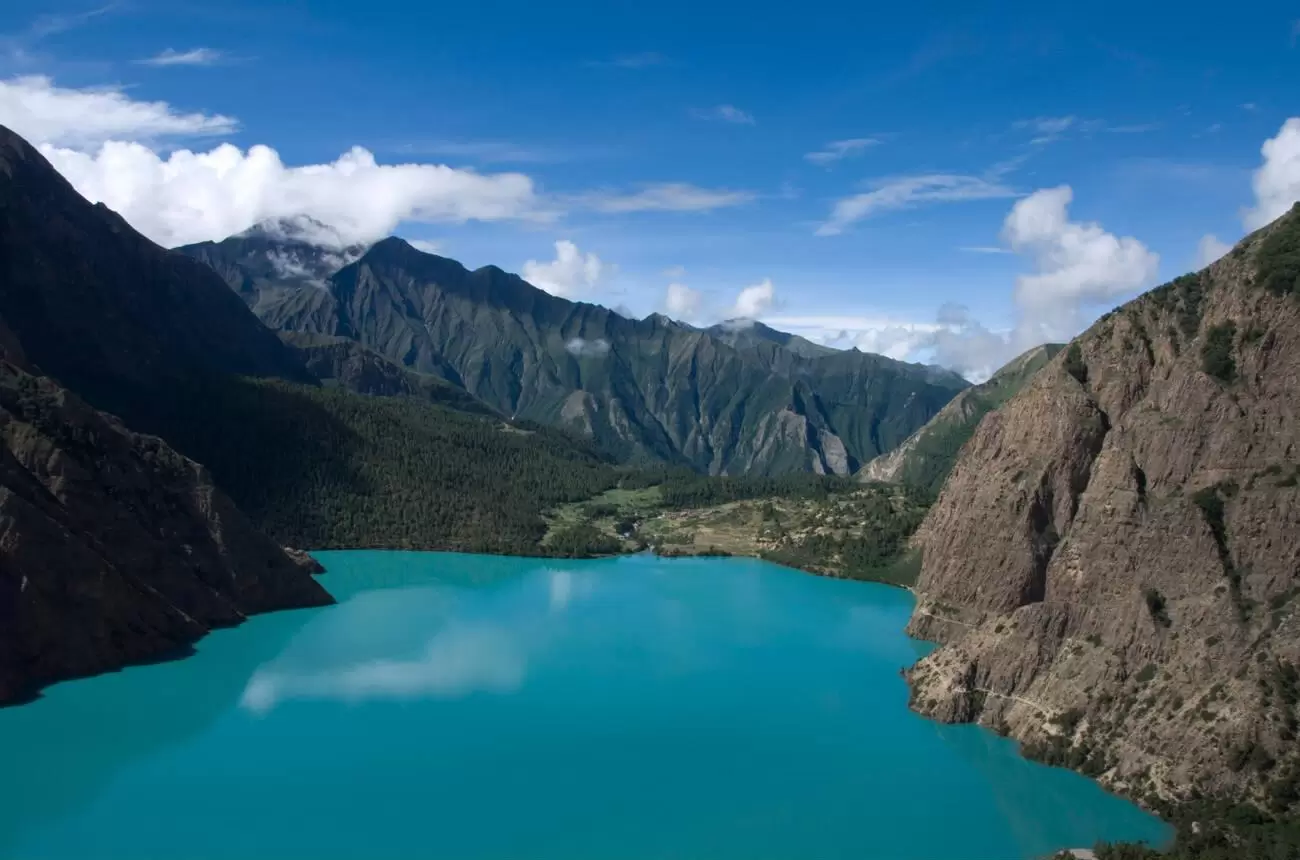
After breakfast, begin your 5-6 hour trek to Phoksundo Lake, one of the most beautiful and remote lakes in Nepal. The lake is famous for its turquoise color and surrounded by steep cliffs and snow-capped peaks. The trek to the lake is scenic, passing through forests and along rivers. Once at the lake, take time to explore the area and enjoy the breathtaking scenery.
Today is a rest day to allow for acclimatization. You can take a short hike around Phoksundo Lake or visit the nearby Phoksundo Monastery, which sits at the edge of the lake. Enjoy the serene atmosphere and beautiful views of the lake, the surrounding mountains, and waterfalls.
Today’s trek takes you from Phoksundo to Sallaghari, a 5-6 hour walk. The trail follows the lake’s northern shore and then ascends through a forested area, offering views of the surrounding peaks. Sallaghari is a small settlement where you will rest for the night.
You will start your journey towards higher altitudes today, trekking for 5-6 hours to reach Nangdala High Camp. The trail ascends steadily, and the landscape becomes more rugged and remote. The high camp offers spectacular views of the surrounding mountains, and you will spend the night here at a basic teahouse or camp.
Today is one of the most exciting days of the trek. You will cross the Nangda La Pass (5,350m), which offers panoramic views of the Dolpo region’s snow-capped peaks. After descending from the pass, you’ll reach Shey Gompa, a revered Tibetan Buddhist monastery located in a stunning location. The trek today takes about 5-6 hours.
After breakfast at Shey Gompa, you’ll trek towards Namgung Gompa, crossing the challenging Shey La Pass at an altitude of 5,100 meters. This section of the trek offers incredible views of the surrounding peaks and valleys. Once at Namgung Gompa, you’ll visit the monastery and rest for the night.
Today, you will descend for 4-5 hours to Saldang, a large village with a rich cultural history. The trail offers beautiful views of the surrounding mountains and traditional stone houses. Saldang is known for its traditional Tibetan culture and its proximity to the Annapurna region.
Today, you’ll rest at Saldang, but for those who are feeling energetic, you can hike to the nearby Yangjer Gumba, a Buddhist monastery perched at a high altitude. The hike provides panoramic views of the surrounding landscapes and allows you to learn more about the local culture.
From Saldang, you will trek for about 6 hours to reach Komash Village, a remote settlement located at an altitude of 4,060 meters. The trail takes you through rugged terrain, offering great views of the mountains and the Tibetan plateau.
Today’s trek will take you to Shimen, a village at 3,850 meters. The journey will take about 6 hours, and the trail winds through a series of picturesque valleys and fields. Shimen offers a peaceful atmosphere, and you’ll stay here for the night.
From Shimen, you will continue your trek for 5-6 hours to Tinje, a village at 4,110 meters. The trail ascends through alpine meadows and rocky paths, with stunning views of the surrounding peaks and valleys.
Today, you will trek for 5-6 hours to reach Yak Kharka, a place known for its grazing yak herds. The trail takes you through rugged mountain terrain, and you’ll enjoy great views of the Dhaulagiri and other peaks.
You will trek to Tokyu today, covering a distance of about 5-6 hours. The trek offers spectacular views of the Dolpo region and the Tibetan plateau. Tokyu is a small village located in a scenic setting, and you’ll stay overnight in a local guesthouse.
From Tokyu, it’s a 5-hour trek to Dho Tarap, where you will have a well-deserved rest day. Dho Tarap is known for its unique culture and Tibetan Buddhist monasteries. Take time to explore the village and relax.
Today, you will descend for 5-6 hours to Naworpani, a small settlement in the Dolpo region. The trek takes you through forests and pastures, offering a final view of the majestic mountains of the region.
Today, your trek will take you further down, with a 6-hour walk to Lashicap. The landscape changes dramatically, and you will begin to see more greenery and vegetation as you descend. Lashicap is a small village where you will stay overnight.
Today, you will trek back to Dunai, where the journey began. It will take around 6 hours, and the trail takes you through forests, rivers, and small villages.
From Dunai, you will trek back to Juphal in 5-6 hours. Once in Juphal, you can relax and reflect on the incredible journey through the remote Upper Dolpo region.
After a short flight from Juphal to Nepalgunj, you will catch a connecting flight to Kathmandu. Upon arrival in Kathmandu, you will be transferred to your hotel, where you can relax and unwind.
After breakfast, depending on your flight schedule, we will transfer you to Tribhuvan International Airport for your departure. Safe travels, and we hope you carry unforgettable memories from your adventure in Upper Dolpo!
The Upper Dolpo Trek is one of the most remote and culturally rich trekking routes in Nepal, located in the far northwest of the country. This trek takes you through the high-altitude region of Dolpo, offering a unique combination of rugged mountain landscapes, ancient Tibetan culture, and pristine wilderness. The trek also passes through beautiful alpine meadows, high mountain passes, and remote Buddhist villages that remain largely untouched by modern development. The Upper Dolpo region is famous for its stunning views of snow-capped peaks, deep valleys, and the Shey Phoksundo Lake, one of Nepal's most beautiful and sacred lakes. The trek is known for its isolation and is often referred to as a journey to "the last Shangri-La."
The best times to trek in Upper Dolpo are during the spring (March to May) and autumn (September to November) seasons. These months offer clear skies, pleasant temperatures, and stable weather conditions, which are ideal for high-altitude trekking. During spring, the region’s flora is in full bloom, making the scenery even more breathtaking, while autumn offers crisp air and beautiful mountain views. The summer months (June to August) are the monsoon season, which brings heavy rainfall and makes trekking conditions challenging. Winter (December to February) is cold, with heavy snowfall, and is not recommended unless you are fully prepared for extreme weather.
The Upper Dolpo Trek is a strenuous and challenging trek, suitable for experienced trekkers who are physically fit and have previous high-altitude trekking experience. The trek involves several high-altitude passes, such as the Numa La Pass (5,190 meters/17,024 feet) and Baga La Pass (5,170 meters/16,962 feet), which can be physically demanding due to their steep ascents and the thin air at higher elevations. The trek also takes you through remote and rugged terrain, where facilities are basic, and you will need to carry your own gear for several days. Proper acclimatization, preparation, and a strong mental attitude are necessary for completing this trek safely.
Yes, the Upper Dolpo Trek requires a guide and porter due to its remote nature and the challenging terrain. The trail is not always well-marked, and having a local guide who is familiar with the area and the culture of Dolpo is crucial for navigation and ensuring your safety. A guide can also enrich your experience by sharing insights into the local Tibetan culture, history, and wildlife. Porters are also recommended to help carry your gear, making your journey more comfortable, especially on the long and difficult stretches of the trek. Nepal Passion Treks and Expedition provides experienced, English-speaking guides and reliable porters who are well-versed in high-altitude trekking.
The Upper Dolpo Trek requires a few special permits due to the region's remote and restricted nature. The most important permits are:
Restricted Area Permit (RAP): Dolpo is a restricted region, and trekkers are required to obtain this permit, which allows access to the area. The RAP is issued by the Department of Immigration in Kathmandu and is valid for specific periods.
Trekking Permit: You will also need a Trekking Information Management System (TIMS) card to register your trek with the Nepal Tourism Board.
Shey Phoksundo National Park Permit: This permit is required to enter the Shey Phoksundo National Park, which is a protected area along the trek. It is also issued in Kathmandu.
Nepal Passion Treks and Expedition will assist with all the necessary paperwork and permits, ensuring that your trek is legally compliant and hassle-free.
Accommodation on the Upper Dolpo Trek is basic, with trekkers staying in local tea houses, guesthouses, and tents in some remote areas. The further you go into the region, the more basic the facilities become. In lower-altitude areas, you may find simple guesthouses offering a bed, a blanket, and basic meals like dal bhat (lentil soup with rice) or Tibetan-style momos (dumplings). As you ascend, the accommodations become more rudimentary, and you may have to camp in tents in some sections of the trek. It’s important to be mentally prepared for these simpler conditions, which are part of the trekking experience in a remote region like Upper Dolpo.
The food along the Upper Dolpo Trek mainly consists of traditional Nepali and Tibetan-style dishes. In the lower regions, you can enjoy dal bhat, momo, noodle soups, rice, vegetables, and eggs. As you progress to higher altitudes, the availability of fresh vegetables and fruits decreases, but you can still expect basic but nutritious meals. In remote areas, you may find foods like tsampa (roasted barley flour), Tibetan bread, and butter tea, which are staples in the local Tibetan diet. Most tea houses also offer a limited selection of snacks, such as chocolates, biscuits, and instant noodles. It’s advisable to bring along energy bars and snacks to supplement the meals.
The highest point of the Upper Dolpo Trek is the Numa La Pass (5,190 meters/17,024 feet), which is one of the most challenging parts of the trek. The pass offers panoramic views of the surrounding snow-capped peaks and is an important milestone for trekkers. Other significant high-altitude locations include the Baga La Pass (5,170 meters/16,962 feet) and the vicinity of Shey Phoksundo Lake. Due to the high altitude, it’s crucial to follow proper acclimatization procedures to minimize the risks of altitude sickness.
The Upper Dolpo Trek typically takes around 22-27 days to complete, depending on the exact itinerary, pace, and acclimatization needs. This includes travel time to and from the trek’s starting point in Juphal, as well as buffer days for acclimatization and potential delays due to weather or other unforeseen circumstances. The trek covers a distance of approximately 200-250 kilometers (124-155 miles), with most trekking days lasting 5-8 hours. The itinerary is designed to ensure gradual altitude gain to allow for proper acclimatization and to minimize the risk of altitude sickness.
Packing for the Upper Dolpo Trek requires careful planning, as the region is remote and conditions can be harsh. Essential items include:
Warm clothing: Layered clothing for warmth, including thermal wear, fleece, and a down jacket.
Waterproof gear:A good quality waterproof jacket, pants, and gaiters to protect against rain and snow.
Trekking boots: Sturdy, waterproof boots suitable for rough and high-altitude terrain.
Sleeping bag: A sleeping bag rated for cold temperatures (down to -10°C/14°F or lower).
Sunscreen and sunglasses:The high-altitude sun can be intense, so proper sun protection is essential.
Water bottles and purification tablets: Clean water can be scarce in remote areas, so it’s essential to have a reliable method for purifying water.
First aid kit:A well-stocked first aid kit, including medications for altitude sickness (consult your doctor before the trek).
Snacks: Energy bars, nuts, and other high-calorie snacks for extra energy during the trek.
Nepal Passion Treks and Expedition will provide you with a detailed packing list and ensure you have all the necessary gear for a successful trek.
While the Upper Dolpo Trek is remote and challenging, it is generally safe if trekkers are well-prepared and follow the guidance of experienced guides. The region’s remoteness means that medical facilities are limited, so it’s important to trek with a reputable company like Nepal Passion Treks and Expedition, which prioritizes safety and provides professional guides trained in high-altitude trekking. Proper acclimatization, good physical preparation, and following the advice of your guide are essential to ensuring your safety during the trek.
Nepal Passion Treks and Expedition is a trusted trekking company with years of experience guiding trekkers through remote regions like Upper Dolpo. We offer personalized service, expert guides, and comprehensive support, including permits, logistics, and gear. Our team is committed to providing an unforgettable and safe trekking experience, ensuring that you have the adventure of a lifetime while respecting the local culture and environment. With our expert guidance, you can explore the untouched beauty of Upper Dolpo with confidence and peace of mind.